
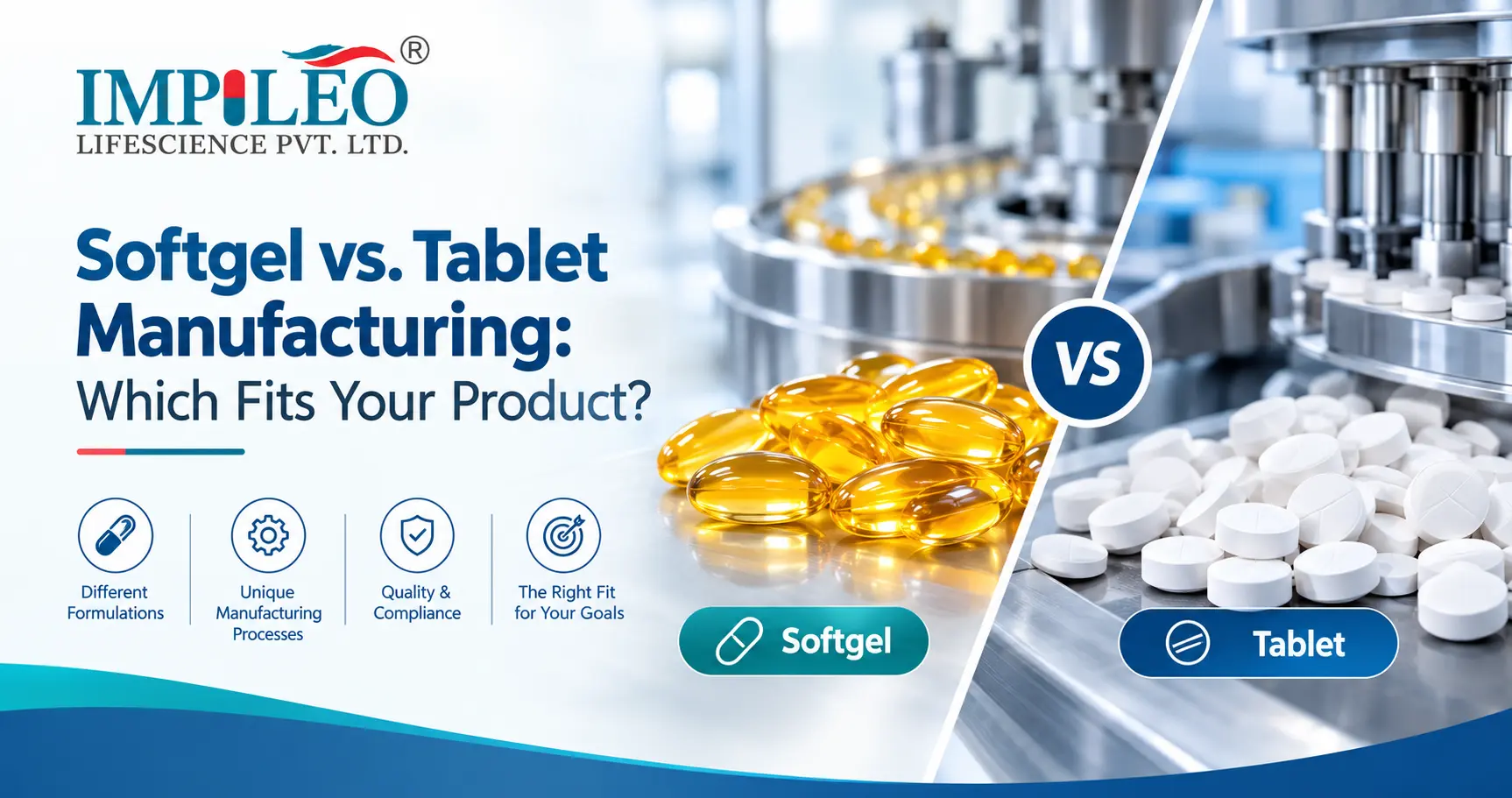
Choosing the right dosage form is an important decision when developing a pharmaceutical, nutraceutical, vitamin, or supplement product. Softgel vs. Tablet Manufacturing involves more than simply choosing between two capsule or tablet formats. Factors such as the active ingredient, stability, absorption requirements, formulation, production process, packaging, cost, and consumer preferences all influence which option is more suitable.
Softgels and tablets are among the most widely used oral dosage forms. While tablets are known for their flexibility, strength, and cost efficiency, softgels can be particularly useful for oils, fat-soluble ingredients, and formulations that benefit from an easy-to-swallow delivery format.
Understanding the differences between the two can help product developers make a more informed manufacturing decision.
What Is the Difference Between Softgels and Tablets?
Softgel capsules are one-piece dosage forms made using a gelatin- or suitable polymer-based shell containing a liquid, semi-solid, or suspension formulation. They are commonly used for oils, vitamins, nutritional supplements, and certain pharmaceutical formulations.
Tablets are solid dosage forms produced by compressing powders or granules into a defined shape and size. Depending on the formulation, tablets can contain active ingredients along with excipients that support compression, stability, disintegration, and manufacturing.
The primary difference is therefore the physical form and manufacturing method. Softgels generally involve shell formation and filling, while tablets require powder or granule preparation followed by compression.
How Does Softgel Capsule Manufacturing Work?
Softgel manufacturing involves several controlled stages to produce a consistent and stable dosage form.
Formulation and Ingredient Preparation
The active ingredient is first formulated into a suitable fill material. Depending on the product, the fill may be an oil, suspension, solution, or semi-solid preparation.
Ingredients must be compatible with the selected shell and should remain stable throughout the product’s intended shelf life.
Shell Formation and Filling
The softgel shell material is prepared before the filling process begins. During manufacturing, the shell is formed, filled with the prepared formulation, and sealed.
Precise control of fill weight, shell thickness, sealing, temperature, and moisture is important for maintaining product consistency.
Drying, Inspection and Packaging
Freshly manufactured softgels generally require controlled drying to achieve the desired shell characteristics.
After drying, capsules are inspected for defects, appearance, weight consistency, and other quality parameters before packaging.
Experienced Softgel Capsule Manufacturers use controlled manufacturing processes and appropriate testing to maintain consistency between batches.
How Does Tablet Manufacturing Work?
Tablet production generally begins with the preparation of the active ingredients and excipients.
Blending and Granulation
Ingredients are accurately weighed and blended to achieve uniform distribution. Some formulations may require granulation to improve flow, compressibility, or content uniformity.
The prepared material is then processed according to the requirements of the formulation.
Compression and Tablet Formation
The blended or granulated material is compressed using tablet manufacturing equipment. Compression force must be carefully controlled because it can influence tablet hardness, thickness, friability, and disintegration.
Different tablet shapes, sizes, and markings can be produced depending on the product requirements.
Coating and Final Packaging
Some tablets are supplied without a coating, while others may receive a film, enteric, or functional coating.
Coating can help improve appearance, swallowing characteristics, stability, taste masking, or controlled release, depending on the formulation.
After inspection and testing, tablets are packed in an appropriate packaging system.
Softgel vs. Tablet Manufacturing: Key Differences
The choice between these dosage forms depends on the product rather than a single universal advantage.
| Factor | Softgels | Tablets |
|---|---|---|
| Physical form | Soft, sealed shell | Compressed solid |
| Typical fill | Liquid, oil, suspension or semi-solid | Powder or granulated formulation |
| Common applications | Oils, vitamins, supplements | Pharmaceuticals, vitamins and supplements |
| Swallowing | Often smooth and easy to swallow | Depends on size, shape and coating |
| Formulation flexibility | Well suited to certain liquid ingredients | Broad range of solid formulations |
| Manufacturing process | Shell formation, filling and sealing | Blending, granulation and compression |
| Coating | Shell provides the outer covering | Optional coating depending on product |
| Packaging needs | Must protect against moisture and physical damage | Depends on tablet stability |
| Appearance | Smooth, often glossy | Can be plain, coated or embossed |
The table provides a general comparison. Actual suitability depends on the formulation, active ingredient, intended use, manufacturing requirements, and regulatory considerations.
When Should You Choose Softgel Manufacturing?
Softgels may be considered when the formulation is better suited to a liquid or semi-solid fill.
They are commonly associated with oil-based ingredients and certain fat-soluble vitamins. Their smooth exterior can also make them convenient for consumers who find some solid dosage forms difficult to swallow.
Softgels can also provide a practical way to encapsulate formulations that are not suitable for conventional tablet compression.
However, they are not automatically the better choice for every product. The compatibility of the fill material with the shell, stability, manufacturing conditions, and packaging requirements should be evaluated before making a decision.
When Is Tablet Manufacturing More Suitable?
Tablets can be a practical option for products containing ingredients that can be effectively processed into a compressible powder or granulated mixture.
They offer considerable flexibility in terms of size, shape, scoring, coating, and release characteristics. Different tablet technologies can also be used to address specific formulation requirements.
For products requiring a solid dosage form, tablets may provide an efficient manufacturing route when the ingredients have suitable flow and compression properties.
The formulation should be assessed for factors such as dose, stability, compressibility, disintegration, and intended release profile before selecting the final format.
Which Dosage Form Offers Better Product Stability?
Stability depends primarily on the formulation and active ingredients rather than whether the product is simply a softgel or tablet.
Moisture, oxygen, light, temperature, and interactions between ingredients can affect product stability. Softgels may require particular attention to shell moisture and environmental conditions, while tablets can also be sensitive to moisture and other storage factors.
Packaging plays an important role in protecting the finished product.
A suitable packaging system should help maintain product integrity throughout transportation, storage, and the intended shelf life. At Impileo Lifescience Pvt. Ltd., packaging is approached with both product protection and user convenience in mind.
How Do Cost and Production Needs Compare?
Manufacturing cost cannot be determined simply by comparing softgels and tablets.
The overall cost can be influenced by raw materials, active ingredient concentration, formulation complexity, equipment, production volume, processing time, packaging, testing, and quality requirements.
Tablets can be efficient for many high-volume solid formulations, while softgels may be more appropriate when the formulation requires a liquid or oil-based delivery system.
Product developers should therefore compare the complete manufacturing requirements rather than focusing only on the cost per unit.
How Should You Select the Right Manufacturer?
The manufacturing partner can significantly influence product consistency and quality.
When evaluating Tablet Manufacturers or Softgel Capsule Manufacturers, consider their experience with the required dosage form, manufacturing capabilities, quality systems, testing procedures, packaging options, and ability to handle the specific formulation.
It is also important to understand how the manufacturer manages raw material quality, in-process checks, finished-product testing, documentation, and batch consistency.
A manufacturer with a strong research and development approach can also help identify formulation and production considerations before commercial manufacturing begins.
Why Do Quality and Research Matter in Manufacturing?
A reliable manufacturing process requires more than production equipment. Research, testing, documentation, and quality controls all contribute to the consistency of the final product.
Quality systems should cover raw materials, manufacturing processes, finished products, and packaging. Compliance with applicable standards and appropriate GMP practices is an important part of pharmaceutical and nutraceutical manufacturing.
Impileo Lifescience Pvt. Ltd. focuses on research-driven product development, rigorous quality testing, WHO and GMP-aligned practices, and the use of suitable ingredients. Its approach also considers environmental responsibility by working toward sustainable materials and reduced waste.
What Role Does Packaging Play in Dosage Form Selection?
Packaging is often considered after the dosage form has been selected, but it should be part of the planning process from the beginning.
Softgels and tablets may have different protection requirements depending on their sensitivity to moisture, oxygen, light, and physical conditions.
The packaging format should protect the product while remaining practical for storage, transportation, dispensing, and everyday use.
User convenience also matters. Easy-to-handle packaging can improve the overall product experience without compromising product integrity.
Softgel vs. Tablet Manufacturing: Making the Final Choice
There is no single dosage form that is best for every product. The right choice depends on the active ingredient, formulation characteristics, intended use, stability requirements, production process, packaging, target users, and commercial objectives.
Softgels can be particularly suitable for certain oils, liquids, and fat-soluble ingredients, while tablets offer broad flexibility for solid formulations and different release requirements.
Before selecting a format, product developers should evaluate the formulation scientifically and discuss manufacturing feasibility with an experienced manufacturing partner.
The goal should be to select the dosage form that provides the right balance of product stability, quality, manufacturability, user convenience, and intended performance.
FAQs About Softgel and Tablet Manufacturing
1. Which is better, softgels or tablets?
Neither dosage form is universally better. Softgels can be suitable for liquid, oil-based, or certain fat-soluble formulations, while tablets work well for many solid formulations. The choice depends on the ingredients and product requirements.
2. Are softgels easier to swallow than tablets?
Softgels have a smooth, flexible outer shell that many people find easy to swallow. However, swallowing comfort can vary depending on capsule or tablet size, shape, coating, and individual preference.
3. Can the same ingredient be made as a softgel and tablet?
In some cases, yes, but the formulation may need to be significantly changed. An ingredient’s solubility, stability, dose, and compatibility with the manufacturing process determine whether both dosage forms are technically suitable.
4. What should I check when choosing Tablet Manufacturers?
Consider manufacturing capabilities, formulation expertise, quality testing, GMP practices, production capacity, packaging options, documentation, and experience with the specific type of tablet required.
5. How do I choose between Softgel Capsule Manufacturers and Tablet Manufacturers?
Start by evaluating the active ingredient and formulation. If the product requires a liquid or oil-based fill, softgel manufacturing may be appropriate. If the ingredients are suitable for compression into a solid dosage form, tablets may be a better option. A formulation assessment can help determine the most suitable route.
Choose the Right Manufacturing Approach for Your Product
Selecting between softgels and tablets is an important part of product development. A well-planned approach considers formulation compatibility, quality, stability, manufacturing feasibility, packaging, and user needs together.
If you are evaluating dosage-form options for a pharmaceutical, nutraceutical, vitamin, or supplement product, Impileo Lifescience Pvt. Ltd. can help you assess the manufacturing requirements and develop an approach suited to your product.
Contact Impileo Lifescience Pvt. Ltd. to discuss your formulation and manufacturing requirements and identify the right dosage form for your product.