
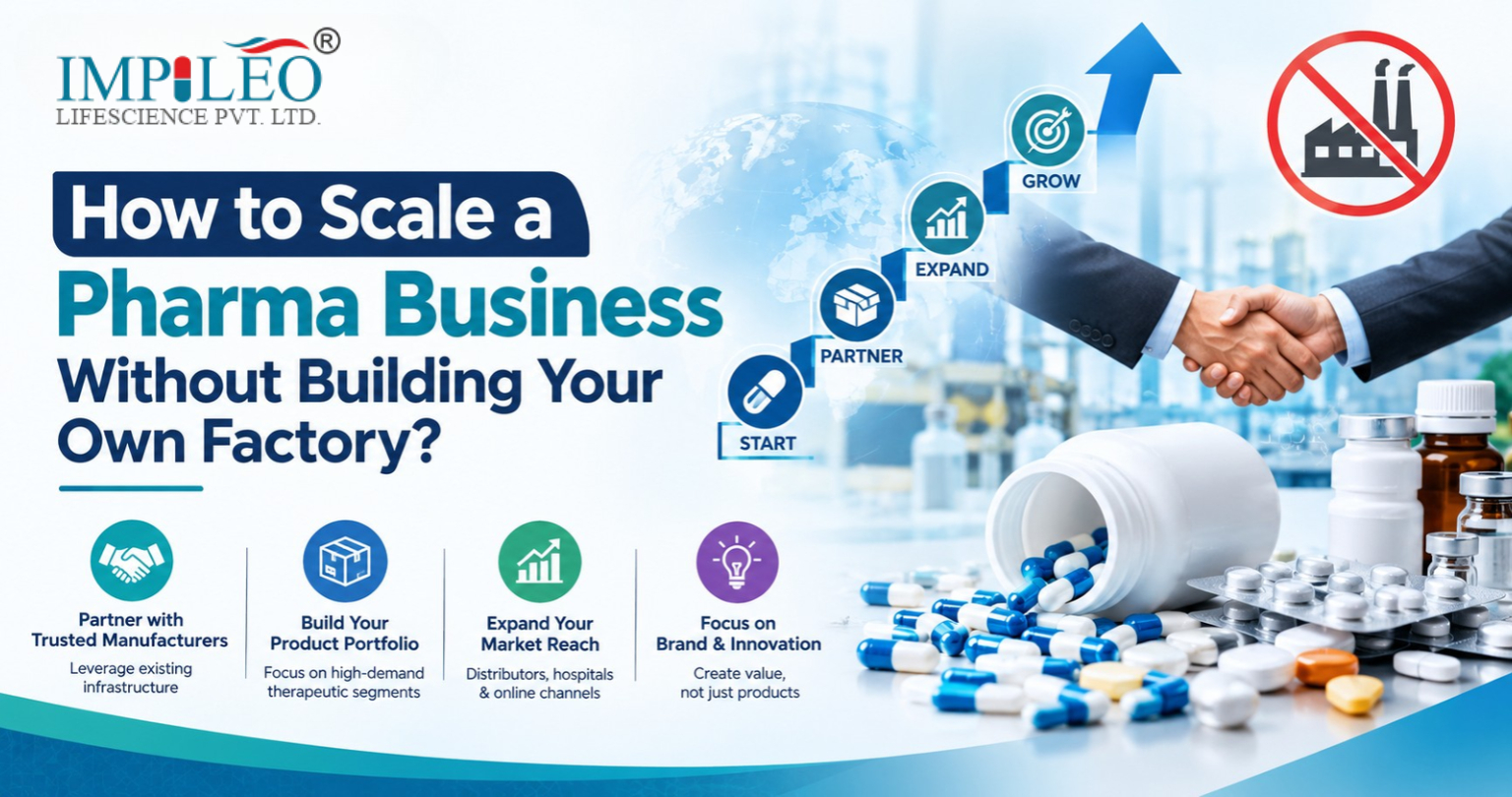
To scale a pharma business successfully, you do not necessarily need to invest in your own manufacturing facility. Pharmaceutical entrepreneurs can expand their product portfolios, reach new markets, and increase distribution through third-party manufacturing partnerships. This approach allows businesses to focus on branding, sales, marketing, and customer relationships while experienced manufacturing partners handle production according to agreed specifications and applicable quality requirements.
Building a pharmaceutical factory requires significant capital, specialised equipment, trained personnel, quality-control systems, regulatory compliance, and ongoing operational expenses. For startups and growing pharmaceutical companies, these commitments can slow expansion and increase financial risk. Working with a suitable third-party manufacturer offers an alternative route to growth, provided the business carefully evaluates product quality, regulatory responsibilities, production capacity, and supplier reliability.
With a clear strategy, pharmaceutical businesses can build a competitive product portfolio without managing their own manufacturing infrastructure. The key is to choose the right partners, understand market demand, maintain quality standards, and create a sustainable distribution network.
Why Pharma Businesses Choose Third-Party Manufacturing?
Third-party pharmaceutical manufacturing allows a business to outsource product production to an external manufacturing organisation instead of operating its own factory. Depending on the arrangement, the business may concentrate on product selection, branding, distribution, and sales while the manufacturer produces formulations under agreed conditions.
This model can benefit businesses at different stages, from new entrepreneurs launching their first products to established distributors expanding into additional therapeutic or healthcare categories.
Reduce Initial Investment and Operating Costs
Establishing a pharmaceutical manufacturing facility involves expenditure on premises, machinery, utilities, technical staff, testing equipment, maintenance, and regulatory systems. These costs can be substantial before a company generates consistent sales.
Third-party manufacturing can reduce the need for direct investment in production infrastructure. Instead, businesses can allocate more of their available capital to inventory planning, marketing, distribution, customer support, and working capital.
However, outsourcing does not eliminate every expense. Minimum order quantities, packaging, testing, transportation, product development, and regulatory obligations must still be considered when calculating the total cost of a product.
Expand Your Product Range More Efficiently
Manufacturing partnerships can make it easier to introduce additional products without independently establishing production lines for every formulation or dosage form.
For example, a business may begin with selected tablets and capsules, then consider syrups, softgels, powders, topical products, or nutraceutical formulations as demand develops. The available options depend on the manufacturer’s capabilities, applicable approvals, and the proposed product specifications.
A phased expansion strategy helps businesses test demand before committing substantial funds to a large product portfolio.
Build a Scalable Pharma Business Step by Step
Scaling a pharmaceutical business requires more than adding products. You need a clear market position, dependable supply, strong distribution, and financial controls that support growth without creating unnecessary risk.
1. Identify the Right Market and Product Demand
Start by understanding the customers and markets you want to serve. Depending on your business model, these may include pharmacies, distributors, healthcare institutions, or other authorised buyers.
Research local demand, competing brands, product availability, pricing, and distribution challenges. Speak with relevant channel partners to understand which products they need and what influences their purchasing decisions.
Avoid selecting products only because they are popular in the market. Consider whether you can source them reliably, maintain appropriate stock levels, compete responsibly, and build sustainable demand.
2. Select a Reliable Third-Party Manufacturer
Your manufacturing partner can directly influence product availability, consistency, lead times, and customer confidence. Evaluate potential suppliers before committing to a long-term arrangement.
Use this checklist when comparing manufacturers:
- Relevant manufacturing licences and product approvals.
- Applicable Good Manufacturing Practice (GMP) compliance.
- Experience with the required formulation and dosage form.
- Quality-control testing and batch documentation.
- Production capacity and realistic delivery schedules.
- Packaging options and minimum order quantities.
- Communication, complaint handling, and corrective actions.
India’s pharmaceutical manufacturing framework includes licensing requirements and GMP provisions under the Drugs Rules, 1945. Schedule M sets out manufacturing practices and requirements for premises, plant, equipment, and quality systems. Verify the manufacturer’s current compliance status and the relevant product permissions before placing an order. CDSCO+1
3. Start With a Focused Product Portfolio
Launching too many products at once can tie up capital in inventory and complicate sales efforts. A more practical approach is to begin with a manageable selection that aligns with your target market and distribution capabilities.
For example, a business may initially focus on selected tablets and capsules before considering additional dosage forms or nutraceutical categories. Expansion should depend on demand, product suitability, manufacturer capabilities, and applicable regulatory requirements.
Use sales data and feedback to identify which products deserve further investment. A focused portfolio is often easier to market, monitor, and replenish than a large collection of products with inconsistent demand.
4. Create a Strong Brand and Distribution Strategy
Manufacturing is only one part of pharmaceutical business growth. Your products also need appropriate positioning, compliant packaging and labelling, reliable distribution, and professional customer service.
Develop a clear brand identity and provide accurate product information. Ensure that all promotional claims, packaging details, and marketing materials comply with the applicable requirements for the product category.
Build relationships with authorised distributors and other relevant channel partners. Set clear commercial terms, establish a process for handling orders, and maintain communication about stock availability and delivery schedules.
Digital channels can support business visibility through a professional website, informative product catalogues, and useful content for prospective business partners. However, marketing activities must follow applicable rules for pharmaceutical promotion and product claims.
Manage Costs, Inventory, and Cash Flow Carefully
Outsourcing production can reduce infrastructure investment, but profitability still depends on how effectively you manage purchasing, stock, credit, and operating expenses.
Calculate the Full Cost of Every Product
Do not compare manufacturers using the quoted production price alone. Calculate the full cost of bringing a product to market, including relevant packaging, testing, freight, storage, distribution, marketing, taxes, and other applicable expenses.
| Cost area | What to evaluate |
|---|---|
| Manufacturing | Quoted price and minimum order quantity |
| Packaging | Labels, cartons, containers, and design |
| Quality and compliance | Applicable testing and documentation costs |
| Logistics | Freight, storage, handling, and delivery |
| Sales and marketing | Promotion, distribution, and customer acquisition |
| Working capital | Inventory holding and customer payment cycles |
Compare the total cost with realistic selling prices and expected demand. Build conservative financial projections and account for possible delays, returns, unsold inventory, and changes in input costs.
Maintain Inventory Without Tying Up Excess Capital
Inventory planning becomes increasingly important as a business expands. Too little stock can interrupt supply, while excess stock can consume cash and increase the risk of expiry-related losses.
Monitor sales trends, supplier lead times, minimum order quantities, and remaining shelf life. Use these details to set reorder points and maintain appropriate safety stock for products with dependable demand.
Apply the first-expiry-first-out principle when handling stock, and maintain appropriate storage conditions. Establish a documented process for monitoring expiry dates, investigating discrepancies, and managing product recalls when required.
Track Business Performance With Useful Metrics
Review a small set of indicators regularly rather than relying on sales revenue alone.
Important metrics include:
- Gross margin by product.
- Repeat orders from customers.
- Inventory turnover and near-expiry stock.
- Order fulfilment and on-time delivery.
- Outstanding payments and cash-flow position.
- Customer complaints and product quality issues.
These indicators can reveal whether growth is financially sustainable or creating operational pressure.
Common Challenges When Scaling Without a Factory
Third-party manufacturing can support expansion, but it does not remove every business challenge. Planning for common risks helps protect customer relationships and maintain continuity.
Dependence on suppliers: Relying heavily on one manufacturer can create supply problems if production is delayed or capacity becomes unavailable. Evaluate backup options where feasible and ensure any alternative manufacturer is appropriately qualified and authorised.
Inconsistent product availability: Unexpected demand or production delays can disrupt distribution. Agree on realistic lead times, communicate forecasts early, and establish a process for handling shortages.
Quality and compliance risks: Outsourcing does not mean quality can be ignored. Define responsibilities for testing, documentation, complaints, recalls, and regulatory obligations in the manufacturing agreement. Confirm that all required licences and product approvals remain appropriate.
Cash-flow pressure: Large minimum orders and delayed customer payments can restrict working capital. Start with realistic order quantities, negotiate suitable commercial terms, and monitor receivables carefully.
Overexpansion: Adding too many products or entering new markets before establishing a reliable sales network can increase costs without generating sufficient returns. Expand in stages, guided by measurable demand and available resources.
How Impileo Lifescience Supports Pharma Businesses?
Choosing a suitable manufacturing and business partner can simplify the process of expanding a pharmaceutical product portfolio. Impileo Lifescience Pvt. Ltd. has operated since 2013, providing PCD pharma franchise and third-party manufacturing services.
Its portfolio covers pharmaceutical, nutraceutical, Ayurvedic, and herbal formulations, including tablets, capsules, softgels, injections, syrups, dry syrups, drops, sachets, ointments, creams, and powders. Availability depends on the specific product, formulation, and applicable approvals.
The company works with manufacturing partners and offers product sourcing, customised packaging solutions, and professional support. These services can be relevant to businesses seeking to develop their product range without investing directly in manufacturing infrastructure.
Before entering an agreement, prospective partners should discuss product specifications, minimum order quantities, pricing, lead times, quality documentation, packaging requirements, and regulatory responsibilities. Clear expectations help both parties build a more dependable working relationship.
Frequently Asked Questions
1. Can I start a pharma business without owning a factory?
Yes. A business can work with an appropriately licensed third-party manufacturer to produce eligible products under an agreed arrangement. You must still meet the applicable licensing, marketing, distribution, and regulatory requirements for your business activities.
2. Is third-party pharmaceutical manufacturing profitable?
It can be profitable when product demand, manufacturing costs, distribution expenses, pricing, and working capital are managed effectively. Profitability depends on the business model and market conditions; outsourcing alone does not guarantee returns.
3. How do I choose a third-party pharma manufacturer?
Evaluate relevant licences, GMP compliance, product capabilities, quality-control systems, batch documentation, production capacity, delivery reliability, pricing, and minimum order quantities. Verify the manufacturer’s credentials and applicable product permissions before committing.
4. Which products should a pharma startup launch first?
Begin with products that match your target customers, market demand, available budget, and distribution capabilities. Evaluate competition, supplier reliability, margins, and regulatory requirements before expanding the portfolio.
5. Does third-party manufacturing remove regulatory responsibilities?
No. Responsibilities depend on the product, licence structure, and activities performed by each party. Businesses should establish clear contractual responsibilities and obtain appropriate regulatory guidance to ensure compliance throughout manufacturing and distribution.
Grow Your Pharma Business With the Right Partner
Scaling a pharmaceutical business without building a factory is possible through strategic outsourcing, focused product selection, reliable distribution, and disciplined financial planning. The strongest approach combines market research with careful manufacturer evaluation, quality oversight, and gradual expansion based on actual demand.
Ready to expand your pharmaceutical product portfolio? Connect with Impileo Lifescience Pvt. Ltd. to discuss third-party manufacturing options, product requirements, and customised packaging solutions for your business. Visit the official website to learn more and take the next step towards sustainable business growth.